When most travelers think of Japan, their minds jump straight to Tokyo’s neon-lit skyline or Kyoto’s iconic temple corridors. But there’s an entirely different Japan waiting to be discovered — one that breathes quietly in misty mountain valleys, sleepy fishing harbors, and centuries-old rural hamlets. This Hidden Japan travel guide is your passport beyond the tourist trail, into the soul of a country that reveals itself slowly, and beautifully, to those willing to look.
From snow-dusted onsen villages and gassho-zukuri farmhouses to coastal fishing towns and forested pilgrimage routes, rural Japan offers a depth of experience that no crowded city block can replicate. Whether you’re a solo adventurer, a cultural explorer, or a travel photographer chasing authentic moments, Japan’s countryside holds stories that most visitors never hear.
🌸 Why Explore Beyond Tokyo — What Hidden Japan Truly Offers
The Real Soul of Japan Lives in Its Small Towns
While Tokyo dazzles with cutting-edge technology and Kyoto impresses with its temple-dense streetscapes, it’s Japan’s rural regions that preserve the country’s most authentic character. In small towns and remote villages, you’ll find tranquil Shinto shrines draped in moss, family-run ryokan inns where grandmothers serve seasonal kaiseki meals, and local matsuri (festivals) celebrated with the same rituals used for hundreds of years.
Venture into the Japanese Alps, the Kii Peninsula, or the Sea of Japan coastline and you’ll witness rice farmers tending paddies by hand, ceramicists shaping clay in open-air workshops, and elders offering tea to strangers as a gesture of genuine welcome. This is the quiet human warmth — omotenashi at its most sincere — that defines Japan’s countryside spirit.
Offbeat Japan for Every Type of Traveler
Hidden Japan isn’t simply about peace and solitude. It’s about discovery in every season — snow-covered hot spring baths in Tohoku, cherry blossom festivals in forgotten valleys, fiery autumn foliage along mountain hiking trails, and hyper-local cuisine you simply cannot find on any city menu. Adventure seekers can tackle forest trails in Nagano, while cultural travelers can join traditional lacquerware workshops in Aizu-Wakamatsu or attend a Noh theater rehearsal in a local community hall in Kanazawa.
If you enjoy exploring lesser-known destinations across Asia, you might also love our guide to Vietnam Adventure Travel – From Mountain Trails to Coastal Waves, which shares a similar spirit of off-the-beaten-path discovery.
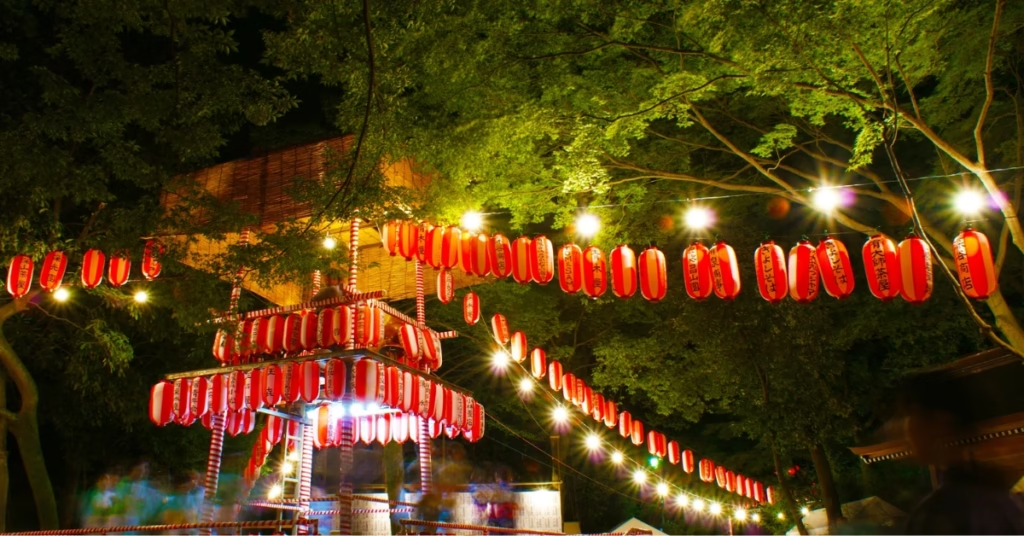
🌅 Top Villages & Towns Featured in This Hidden Japan Travel Guide
Every corner of rural Japan carries a story — from weathered farmhouses to mountain temples perched above sea-level clouds. Below are some of the most breathtaking offbeat destinations to include in your Japan itinerary, each offering a window into a way of life that feels worlds apart from urban Japan.
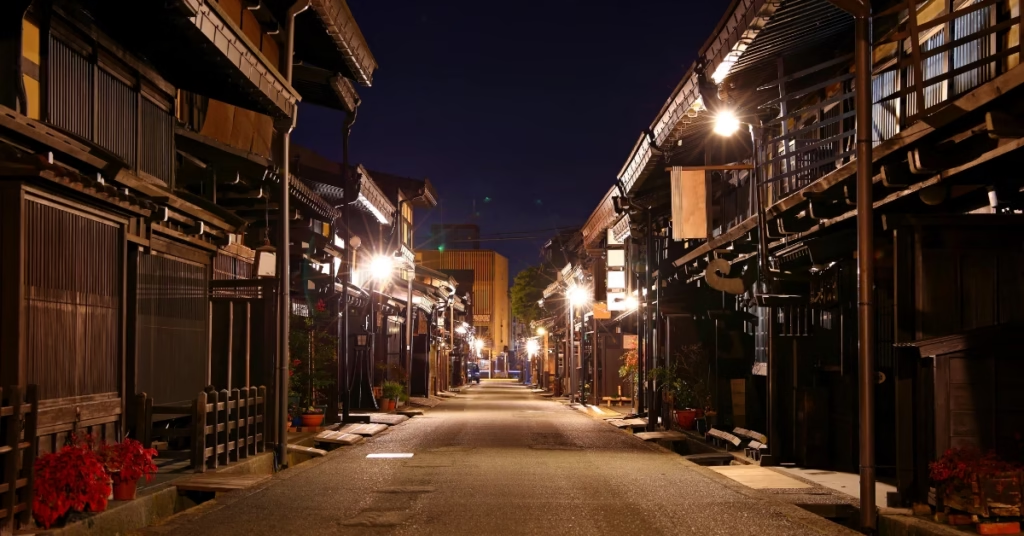
🏯 Takayama — Mountain Traditions & Edo-Era Old Town Charm
Nestled deep in the Japanese Alps of Gifu Prefecture, Takayama is a beautifully preserved castle town that combines Edo-period architecture, artisanal craftsmanship, and mountain serenity in one compact, walkable area. The narrow stone lanes of Sanmachi Suji are lined with dark wooden merchant houses, sake breweries still fermenting traditional rice wine, and craft boutiques selling hand-carved shunkei lacquerware and Hida woodwork.
Start your mornings at the famous Takayama Morning Market (Jinya-mae Ichinichi), where vendors sell fresh mountain vegetables, pickled plums, and locally made miso. Then head to the Hida Folk Village (Hida no Sato), an open-air architectural museum where dozens of traditional farmhouses have been relocated and restored, offering a vivid picture of rural Hida life across the centuries.
By evening, settle into a local izakaya for a plate of Hida beef sushi — a regional delicacy that rivals even the most celebrated wagyu experiences in Japan. If you’re visiting in April or October, the legendary Takayama Festival fills the streets with ornate yatai floats and traditional performing arts, considered among the three greatest festivals in all of Japan.
- Best time to visit: Spring (April) for festivals; Winter (December–February) for snowy mountain landscapes
- Getting there: Direct limited express train from Nagoya (2.5 hrs) or Toyama (1.5 hrs) via the scenic Hida route
- Stay: A traditional ryokan in the old town for full immersion
🏡 Shirakawa-go — A UNESCO World Heritage Village Frozen in Time
Few places in Japan inspire as much wonder as Shirakawa-go, a UNESCO World Heritage Site celebrated for its iconic gassho-zukuri (hands-in-prayer) thatched-roof farmhouses. Set in a wide mountain valley flanked by forested ridges in Gifu Prefecture, this village feels less like a tourist attraction and more like a living museum — because it genuinely is one. Families still live and farm here, continuing agricultural traditions their ancestors practiced over three centuries ago.
The steeply pitched roofs — some rising up to nine meters — were engineered specifically to shed the region’s notoriously heavy snowfall, and in winter, the entire village transforms into a scene of surreal, postcard-perfect beauty. Visit the Shiroyama Observation Deck for a sweeping panoramic view of the valley, and walk through the Wada House Museum, one of the largest and oldest gassho farmhouses open to visitors, to understand how extended families once lived and worked under a single massive roof.
- Don’t miss: The winter light-up events (late January–February), when the snow-covered village is illuminated after dark
- Stay overnight: Book a farmhouse guesthouse (minshuku) for an experience unlike anything else in Japan
- Getting there: Bus from Takayama (50 mins) or Kanazawa (75 mins); private car gives you more flexibility
🎨 Kanazawa — Japan’s Hidden Cultural Capital
Often called the “Little Kyoto” of the Sea of Japan coast, Kanazawa somehow escaped World War II bombing and emerged with its historic districts almost entirely intact. This gives the city a rare, layered authenticity: geisha quarters (Higashi Chaya), samurai residential neighborhoods (Nagamachi), and centuries-old craft traditions — particularly Kaga Yuzen silk dyeing and gold leaf production — all coexist within easy walking distance.
The crown jewel is Kenroku-en Garden, one of Japan’s three great landscape gardens, a masterpiece of Edo-period horticultural design that shifts through spectacular visual identities with every season. Pair that with a visit to the striking 21st Century Museum of Contemporary Art, and you have a destination that bridges Japan’s ancient heritage with its cutting-edge creative culture.
- Local food: Try fresh jibuni (duck stew) and noto beef at a traditional restaurant in the Omicho market area
- Getting there: Shinkansen from Tokyo (2.5 hrs) or train from Osaka (2.5 hrs via Thunderbird express)
- Best for: Culture lovers, food travelers, photographers, and anyone who appreciates craft heritage
⛩️ Kii Peninsula & Kumano Kodo — Sacred Pilgrimage Trails
For travelers seeking something genuinely transformative, the Kumano Kodo pilgrimage network on the Kii Peninsula (Wakayama and Mie Prefectures) offers one of the world’s most profound walking experiences. These ancient forest trails have connected worshippers to the three Grand Shrines of Kumano — Hongu Taisha, Hayatama Taisha, and Nachi Taisha — for over a thousand years. Remarkably, the Kumano Kodo shares UNESCO recognition with Spain’s Camino de Santiago as a dual World Heritage pilgrimage route.
Walking these moss-carpeted stone paths through ancient cedar forests, past roadside stone jizo statues and centuries-old oji (sub-shrine) markers, creates an atmosphere of stillness and reverence that’s hard to articulate and impossible to forget. The region’s Nachi Waterfall — Japan’s tallest at 133 meters — and its adjacent vermillion-painted pagoda form one of the most iconic natural and spiritual landscapes in all of East Asia.
- Trail options: The Nakahechi route is most accessible for international visitors (3–5 days)
- Stay: Traditional guesthouses and Buddhist temple lodgings (shukubo) along the trail
- Getting there: Train from Osaka to Shirahama or Kii-Tanabe, then local bus networks
Fans of multi-day trekking through culturally rich terrain might also appreciate our detailed guide on Hiking the Lost City Colombia: The Most Legendary Jungle Trek — a similarly spiritual and physically rewarding journey on the other side of the world.
🌊 Ine — Japan’s Most Picturesque Fishing Village
Tucked into a sheltered bay on the northern coast of Kyoto Prefecture, Ine is arguably Japan’s most photogenic fishing village — and one of its least visited. The defining feature here is the funaya: traditional boathouses built directly over the water, where the ground floor serves as a garage for fishing boats and the upper floors house the fishing family. Around 230 of these remarkable wooden structures line the gentle horseshoe-shaped inlet, a designated Important Preservation District for Groups of Historic Buildings.
Arrive by boat from Amanohashidate for a view of the funaya that you’ll struggle to capture in a single photograph. Hire a local boat guide to tour the bay at dawn, buy fresh buri (yellowtail) sashimi directly from fishermen, and spend the night in a funaya guesthouse with the sound of water lapping beneath the floorboards.
- Best time to visit: Year-round, though spring and autumn offer the most dramatic light for photography
- Getting there: Bus from Kyoto Station (approx. 2.5 hrs) or ferry from Amanohashidate
- Crowd factor: Extremely low — most domestic tourists haven’t discovered it yet
🏔️ Nagano & the Matsumoto Region — Alps, Onsens & Snow Monkeys
Nagano Prefecture is perhaps the most versatile region in this hidden Japan travel guide — a vast alpine canvas that accommodates skiers, hikers, history buffs, and wildlife watchers with equal generosity. The region’s most famous residents are the Japanese macaques (snow monkeys) of Jigokudani Monkey Park, who soak in natural hot spring pools surrounded by winter snow — a wildlife spectacle found nowhere else on Earth.
Matsumoto City anchors the region with its magnificent Matsumoto Castle, a rare original black-walled fortress (not a concrete reconstruction) dating from the 16th century, reflected perfectly in the surrounding moat. From here, day trips into the Northern Japan Alps — including the dramatic Kamikochi valley — offer world-class alpine scenery and hiking trails through pristine wilderness.
The nearby Bessho Onsen and Yudanaka Onsen villages provide authentic hot spring bathing experiences in old wooden bathhouses, far removed from the resort-style onsen towns that dominate travel brochures.
- Adventure options: Hiking, skiing (Hakuba Valley), cycling the wine road, river kayaking
- Getting there: Shinkansen from Tokyo to Nagano (80 mins); Matsumoto by limited express from Shinjuku (2.5 hrs)
- Combine with: A side trip to Takayama via the scenic Matsumoto-Takayama mountain route
🍜 Regional Foods You Must Try in Hidden Japan
One of the greatest joys of traveling through rural Japan is eating like a local — and every region has its own deeply distinctive culinary identity, shaped by geography, seasons, and centuries of tradition. Here’s a regional food map to guide your appetite:
- Hida Beef (Takayama): Exquisitely marbled wagyu from Gifu’s mountain-raised cattle — try it as sushi, sukiyaki, or simply grilled
- Jibuni (Kanazawa): A hearty duck and wheat gluten stew simmered in a dashi-based broth — Kanazawa’s most iconic winter dish
- Soba Noodles (Nagano): Nagano produces some of Japan’s finest buckwheat; order zaru soba cold-served with dipping broth at any local restaurant
- Kaki (Oysters) on the Sanriku Coast: The Tohoku coastline produces plump, mineral-rich Pacific oysters eaten raw or grilled over charcoal
- Kumano Hongu’s Tofu Cuisine: Along the pilgrimage trail, traditional Buddhist vegetarian cuisine (shojin ryori) centered on locally made silken tofu offers a meditative dining experience
- Sansai (Mountain Vegetables): Foraged wild greens, fern shoots, and mushrooms served tempura-style or in miso soup across alpine regions
🗓️ Best Time to Visit Hidden Japan — Seasonal Guide
Unlike Tokyo and Osaka, which remain popular year-round, rural Japan’s appeal shifts dramatically with the seasons — and timing your visit right can mean the difference between a good trip and an unforgettable one.
Spring (March–May) — Cherry Blossoms & Festivals
The sakura (cherry blossom) season sweeps through Japan’s countryside in late March to mid-April, transforming riverbanks, castle grounds, and mountain paths into corridors of pale pink and white. Rural areas see far less crowd pressure than Ueno Park or Maruyama Park, making village blossom-viewing a genuinely serene experience. The Takayama Spring Festival (April 14–15) is one of the most spectacular in Japan.
Summer (June–August) — Festivals & Mountain Hiking
Summer brings Japan’s legendary matsuri (festival) season — towns host bon odori dances, firework displays, and regional food markets. This is also peak season for hiking in the Japanese Alps and exploring the Kumano Kodo trail before autumn rains arrive. Expect humidity in lower areas but refreshingly cool temperatures at altitude.
Autumn (September–November) — Foliage & Harvest Season
Koyo (autumn leaf season) turns Japan’s mountains into a blazing tapestry of red, orange, and gold from late September through November. Nikko, Shirakawa-go, and the Kiso Valley are among the most dramatic locations for fall foliage, and many rural areas hold harvest festivals celebrating the rice and sake-making seasons.
Winter (December–February) — Snow Villages & Onsens
Winter is arguably the most magical season for hidden Japan. Shirakawa-go’s illuminated snow village, Jigokudani’s bathing snow monkeys, and the chance to soak in an open-air rotenburo hot spring bath while snowflakes fall around you — these are experiences that define Japan’s quieter, deeper beauty. Ski resorts in Hokkaido and Nagano also attract powder enthusiasts from across the globe.
🚆 Getting Around Rural Japan — Practical Transport Tips
Navigating Japan beyond the major cities requires a bit more planning, but the country’s transportation infrastructure makes it surprisingly accessible even for first-time visitors.
- JR Pass: The Japan Rail Pass covers most express and shinkansen services nationwide — essential for long-distance rural travel. Buy it before you arrive in Japan
- Local Buses: Many mountain villages are only accessible by regional bus. Download the Japan Bus Online app or pick up timetables at major train stations
- Rental Car: In regions like the Kii Peninsula, Tohoku, or Hokkaido, renting a car gives you unparalleled freedom — roads are well-maintained and signage is bilingual
- IC Cards (Suica/Pasmo): Preloaded transit cards work on local trains, buses, and even convenience stores across Japan — get one at any major airport
- Cycling: Many rural towns — including Takayama and Kanazawa — are perfectly sized for exploring by bicycle, with rentals widely available near train stations
🏨 Where to Stay — Accommodation in Rural Japan
Ryokan (Traditional Japanese Inn)
A ryokan stay is not merely accommodation — it’s a cultural immersion. Expect tatami-mat rooms, futon bedding, yukata robes, communal hot spring baths, and elaborate multi-course kaiseki dinners prepared from seasonal, regional ingredients. Many of Japan’s finest ryokans are found not in cities but in small onsen towns — precisely where this guide leads you.
Minshuku (Family Guesthouse)
Minshuku are the Japanese equivalent of a B&B — family-run guesthouses offering simple rooms and home-cooked meals at very reasonable prices. They’re common in smaller villages like Shirakawa-go and along pilgrimage routes, and staying in one often means direct, genuine interaction with local families.
Shukubo (Temple Lodging)
Along the Kumano Kodo and in monastic communities like Koyasan, shukubo temple lodgings allow travelers to sleep within sacred Buddhist grounds, participate in pre-dawn meditation ceremonies, and share vegetarian shojin ryori meals with monks. A truly once-in-a-lifetime experience.
🌿 Responsible Travel in Hidden Japan — Etiquette & Respect
Rural Japanese communities are welcoming, but they are also fragile. The rise of global tourism has put pressure on small villages that were never designed for large visitor volumes. Traveling responsibly ensures these places remain authentic and accessible for future generations.
- Stay quiet in residential areas — many “tourist” villages are real neighborhoods where people live and work
- Follow onsen etiquette — rinse thoroughly before entering communal baths; tattoos may restrict access at some traditional facilities
- No drone photography in sacred sites, national parks, or over private property without explicit permission
- Support local businesses — eat at family restaurants, buy crafts directly from artisans, and book local guides rather than large tour operators
- Learn a few Japanese phrases — even a simple arigatou gozaimasu (thank you very much) goes a long way in rural communities
- Pack out your rubbish — many small villages have no public bins; carry a small bag for your own waste
If your travel philosophy extends to exploring Asia’s hidden corners with sensitivity and depth, our guide to Mongolia Adventure Travel – Explore the Gobi Desert & Nomadic Highlands offers another perspective on immersive, respectful travel through cultures that rarely see the tourist spotlight.
📋 Hidden Japan Travel Guide — Quick Reference Summary
- Top destinations: Takayama, Shirakawa-go, Kanazawa, Ine, Kumano Kodo, Matsumoto, Jigokudani
- Best season: Spring (cherry blossoms) and Autumn (foliage) for most regions; Winter for snow villages and onsens
- Ideal trip length: 10–14 days to meaningfully explore 3–4 rural regions
- Budget range: Mid-range (ryokan stays + regional rail) — approximately $100–200 USD per person per day
- Essential apps: Google Maps (offline), HyperDia (train timetables), Japan Official Travel App
- Currency: Japanese Yen (JPY) — rural areas are still largely cash-based; carry sufficient yen
- Language: English signage is improving but limited in very rural areas — download Google Translate with Japanese offline pack
✈️ Final Thoughts — Why Hidden Japan Belongs on Your Bucket List
The Japan that most travelers experience — the high-speed bullet trains, the Shibuya crossings, the bamboo groves of Arashiyama — is extraordinary. But it is only the surface. Beneath it lies a quieter, older, more intimate Japan: a country of mountain priests and coastal fishermen, of artisans who’ve spent forty years perfecting a single craft, of village festivals attended by the same families for twenty generations.
This Hidden Japan travel guide isn’t about rejecting the popular — it’s about going deeper. It’s about choosing the mountain path over the highway, the farmhouse meal over the Michelin-starred restaurant, the local festival over the packaged tour. That choice, made even once during your Japan journey, will change how you see the country — and perhaps how you travel everywhere else.
For more inspiration on exploring Asia’s most rewarding destinations beyond the obvious, read our comprehensive guide on Adventure Travel in Japan – Hidden Destinations Beyond Tokyo.
